Out of hibernation

OK, I confess, I’ve been in full-on hibernation mode. The irony is not lost on me that the topic of my last post of Winter Solstice and here we are having just passed the Spring Equinox. An entire season has passed! Not that I didn’t have good intentions or ideas or inspirations, it was simply hibernating and it just happened. I adore the seasons and they have so much to teach us. To be honest, while I was walking around in awe of the discreet beauty of winter and drinking pot after pot of tea to keep warm, I also felt lazy, undisciplined, and even guilty. Would I think that about a tulip bulb or a lilac bush or an oak tree? Can you imagine the rare critter scattering about looking at an oak tree in January and thinking, “I can’t believe how unproductive you are right now, what a lazy lump!” But what is there really to do when the sky is dark and the ground is cold? Just be. Have patience. Trust that light and warmth will return. Full trees and colorful blossoms would look out of place in a winter landscape. It would be forced and unnatural. To everything turn, turn, turn, There is a season turn, turn, turn, And a time to every purpose, Under heaven.

A few years ago I had the privilege of attending a David Hockney exhibit in San Francisco. He had moved from Los Angeles back to England and spent several years capturing the same landscape scenes during each season in a variety of mediums. I felt so much emotion at this exhibit because it captured the nuances and unique beauty of each season. When it was on display with all the seasons together it was so complete and stunning.

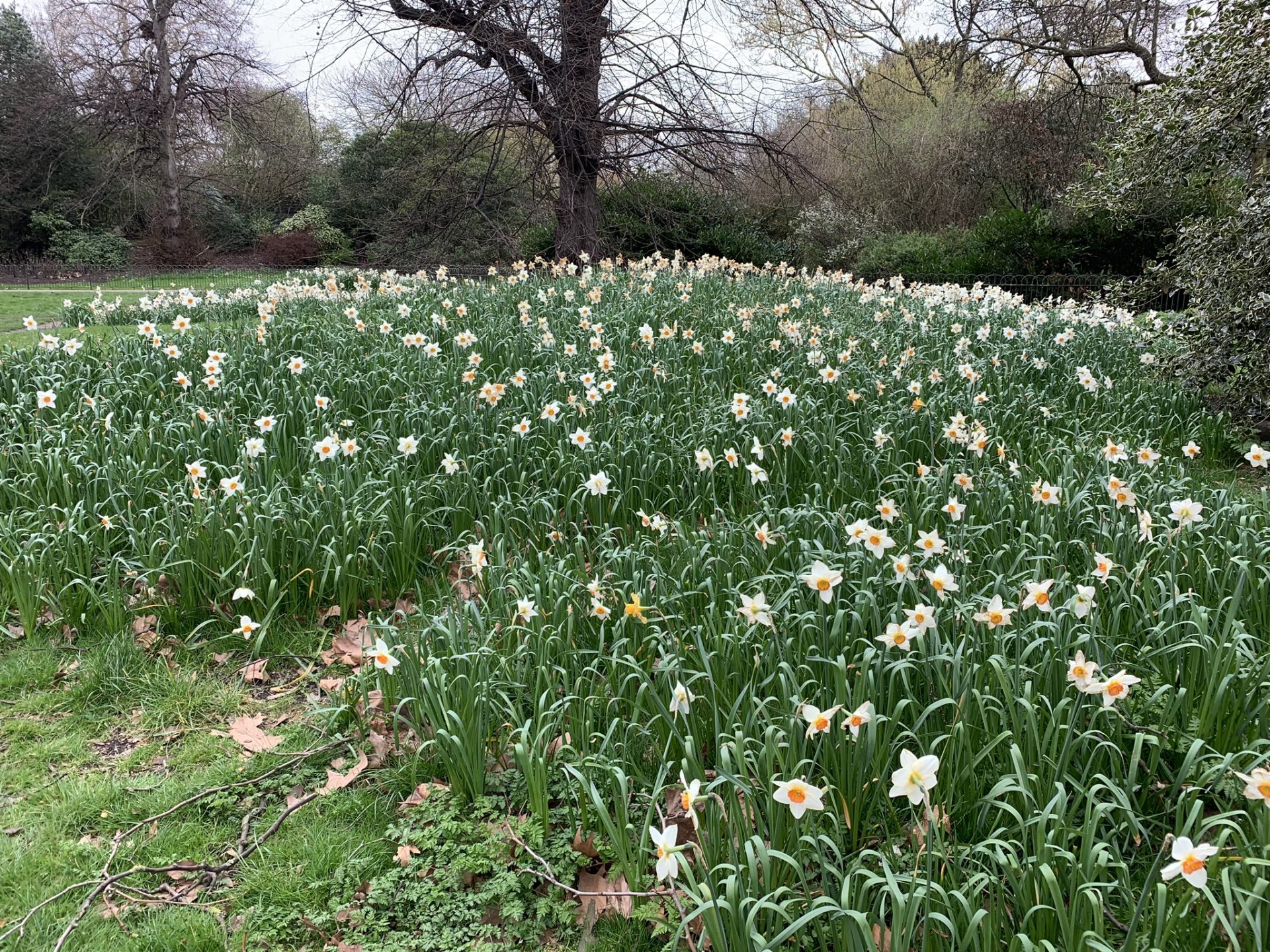
Like Hockney, I spent decades on the California coast, famous for its mild, stable weather and lack of seasons, and recently moved to England. In less than eight months, experiencing proper seasons has been one of my greatest joys living here. I wasn’t sure how I would find the winter being colder and darker than I was accustomed to. Surprisingly, I found it very beautiful in understated ways, tranquil, pensive, steady, and predictable. But not entirely: very subtly almost without notice, the days start getting a little longer each week, a little warmer. One morning, the birds are singing and another morning daffodils are sprouting up and offering the welcome gift of color. A few days later, the bare trees start to fill in with buds, tiny at first and then growing bigger each week until the first leaves pop out. Our senses gradually start to adjust to the sounds and colors of life where there has been none. It signals us to become alive too. The change of scenery reminds us that its time to show our vibrant colors and to begin the process of growing to our greatest heights and be filled with the warmth and energy of the sun and our surroundings. It reminds us that it’s time to leave behind the sleeping, introspective, quietness of winter and be grateful for the time of rest and renewal and recharge.

We all need periods of winter in our lives. Unfortunately, calm, still, thoughtful, and dormant are most often not valued characteristics in modern life that instead prefers high energy, productivity, and activity all the time incessantly! It’s not sustainable because it’s out of balance. It becomes forced and unnatural, it’s not complete. I encourage everyone to honor the season that you find yourself in in various areas of your life and allow the beauty and magic of each season run its course. If you’re feeling the spring energy like I am, what seeds will you be planting now that the ground has thawed? How high will you fly? How full will you grow? Will you take a class? Travel to a new place? Try a new recipe? Spend more time with friends and family? Do you need to allow yourself to be reflective and serene and have a winter season that you may have missed? Most importantly, how have you been hibernating? What parts of yourself have been dormant and need to come back to life? Happy spring! May you be filled with energy and vitality and may blossoms flourish in your life!

Reclaiming sleep – your health and longevity depend on it!

“Amazing breakthrough! Scientists have discovered a revolutionary new treatment that makes you live longer. It enhances your memory and makes you more creative. It makes you look more attractive. It keeps you slim and lowers food cravings. It protects you from cancer and dementia. It wards off colds and flues. It lowers your risk of heart attack and stroke, not to mention diabetes. You’ll even feel happier, less depressed, and less anxious.”      -Matthew Walker, Why We Sleep

Healthy diet. Check. Exercise. Check. Positive attitude. Check. Meditation. Check. Sleep. Ummmm…

Sleep is likely the most important thing we aren’t doing enough of.

Last year, I decided to take a serious look at my sleep habits. I was in the habit of staying up late since back when I was in high school and college. More recently, I had been staying up late regularly working on plans for my clients including recommendation for them to improve their sleep to support their health goals. The irony was not lost on me and I realized that I need to go through my own process and get a deeper understanding of sleep, as well as to model good sleep habits.

The first thing that came to my attention was that in our modern high tech fast-paced world, good sleep requires DISCIPLINE. Just like eating and exercise, we will automatically revert back to our normal habits unless we make a plan and a commitment to stick to it. Yes, changing sleep patterns requires a lot of focus and attention just like changing any other habit.

So of course, that begs the question, is all the effort really worth it? We all want high returns on our investments. Remember the phrase, “I’ll sleep when I’m dead.“ that was popular in the 80s? And somehow that sense of pride when pulling all-nighters and “surviving” on very little sleep. The key word here is survive and according to sleep research, you’ll be dead sooner than later if you don’t get enough shut-eye. Consider what your health and your best daily performance is worth to you and you will soon understand why prioritizing sleep is possibly THE most important thing for your well being. UN the 2017 book, Why We Sleep, Matthew Walker puts it very bluntly, “The shorter your sleep, the shorter your life span.” In other words, if you don’t snooze, you lose.

Citing numerous research studies in recent years, Walker catalogues that sleep is beneficial to all mental, physical, and emotional functions including immunity, cognitive performance and memory, creativity, mood regulation and social cues, digestion, circulatory health, weight regulation, exercise recovery, cellular repair, and hormone balance. He explains that “sleep dispenses a multitude of health insuring benefits” and that we are missing out on when we short change our sleep. It’s literally true that “Sleep is the best medicine”.

So how much sleep do we really need? We tend to get stuck on the average figure of 8 hours per night, but as Nick Littlehales points out in his book Sleep, that’s just an average. The main idea is that you feel rested and have energy after sleeping. Many people will be at their best at nine hours per night and some may do well with between seven and eight. In her book Lights Out, T.S. Wiley elaborates on the relationship between sleep and our circadian rhythms. She suggests that most of us are more likely to require more sleep in the dark winter months and much less in the summer months with long hours of daylight. We are programmed at a cellular level to be in rhythm with the natural cycles of day and night.  The invention of the electric light bulb along with a constant drive for achievement and productivity at all costs has jolted us from that natural tendency.

Want to start enjoying all the health benefits of sleep? It’s time to make a plan. Just like diet and exercise, most of us already know that our sleep habits can be better. The first step is noticing how you feel in the morning and what are the various reasons that you may not sleep when you are actually tired. Also, take note of times during the day that you tend to feel sluggish and tired. Here are a few tips to steer you in the right direction. See which ones will work best for you and notice how you feel as your sleep habits are improving.

  • Set a bedtime that allows for plenty of sleep and use an alarm to stick to it. Be sure to allow time to prepare for bed so that you are not rushing to get in bed at the chosen time.
  • If you have been staying up very very late, try going to bed 10 minutes earlier each night until you reach the desired bedtime. This will be less of a shock to the system and more likely to lead to successful results.
  • Turn off electronics 1 hour before bed. Just like bedtime, build up to it gradually.
  • Be sure that electronics block blue light after sunset – be especially mindful of big tv screens – wear blue light blocker glasses if necessary.
  • Write in a journal or jot down a to-do list to clear your mind to prepare for sleep
  • Limit alcohol, sugar, and food before bed.
  • Cut off caffeine after 2 pm.
  • Take a warm bath in the evening.
  • Use calming essential oils like lavender or cedarwood to help you relax.
  • Open a window to keep the room cool. Studies show we sleep better in a cool room.
  • Make the room really dark or wear eye shades.
  • Allow yourself to take a 30-90 minute nap in the afternoon if your schedule permits.

Books related to sleep and habits
Duhigg, Charles, The Power of Habit; why we do what we do and how to change
Huffington, Ariana, The Sleep Revolution
Littlehales, Nick,  Sleep
Pang, Alex, Rest; Why you get more done when you work less
Walker, Matthew, Why We Sleep
Wiley, T.S., Lights Out 


Forget Exercise – MOVE MORE!!

“Sitting is the new smoking.” Have you heard that expression lately? When I see so many people spending hours watching Netflix and YouTube videos while having meals delivered to their door, it reminds me of the scenes in the Pixar film Wall-E just sitting with their feet up, a milkshake in one hand, and a remote control in the other. It turns out that high levels of inactivity contribute to poor physical, emotional, and mental health and there’s an easy fix – simply move more.

Exercise is like a healthy diet. We all know we need to do it, and it easily ends up turning into some sort of chore and part of our to-do list. Did you know that someone who hits their gym quota just to spend the rest of the time sitting at a desk or driving or other sedentary activities can still be at heath risk for inactivity? It’s about having consistent periods of movement through the day. We are at a point that many of our daily habits and routines do not incorporate sufficient movement to promote optimal cellular function as well as mental and emotional wellness. It didn’t happen by accident, but it’s time to pay attention. Considering the idea of increased physical activity all day long rather than just isolated periods specifically dedicated to exercise will get us off to a good start.

Not only are we not moving, our movements tend to be quite limited, activating only a small set of muscles and postures. For example, these day, most of us don’t even have to turn our bodies and necks when reversing the car because we have cameras rear view cameras in the car to look at instead. Move more literally means more kinds of movements too, not just more of what we’re already doing. When was the last time you sat on the floor? Sitting on the floor and standing up from sitting on the floor engages a whole set of movement patterns in your body. It may be uncomfortable, but that’s just because we don’t do it often enough. Movement includes wrist and ankle rolls while laying in bed, moving your head from side to side in the shower, side stepping to the kitchen, spinning in circles and shaking your booty to your favorite tunes. Movement is crawling on the floor with your small child. It’s reaching, kneeling, hanging, squatting, twisting, jumping, pushing, pulling, balancing, and anything you can imagine. Fidgeting is movement too, so if you’re a fidgeter, then go for it! It’s actually much easier than we make it out to be when the gold standard has been sessions at the gym for so long.

In a 2012 study entitled, “Lack of Exercise is Major Cause of Chronic Disease” The Comprehensive published in the Journal of Physiology, researchers cite lack of exercise as a major cause of chronic disease. This includes heart disease, diabetes, obesity, fatty liver disease, cancer, insulin resistance, metabolic syndrome, osteoporosis, osteoarthritis, stroke, pain, constipation, and even anxiety and depression. Notice that this is not limited to physical health problems.; mental and emotional health is equally at risk in relation to lack of movement. In this study, inactivity was cited as the PRIMARY cause of 35 different conditions. Physical activity and movement are related to strength, balance, and flexibility. Movement is good for us any way you look at it. My favorite quote from the study is: “Physical activity is the primary prevention of physical inactivity.” This really means that it’s not enough to know that we need to do it, we actually have to do it – get out there and MOVE!

Movement increases focus, attention, clarity, and even creativity. When I was in graduate school a few years ago, it was the first time that I consciously recognized that I could think much better when moving. Sitting at my desk with all my books and notes just wasn’t making the ideas flow. I expect this may be the case for many of us. Have you ever gone for a walk and been filled with ideas or inspiration? Or had unexpectedly interesting and deep conversations while hiking? Even now, a huge part of my writing process is heading out for a walk to allow my ideas to percolate and develop before sitting down with my notebook. That may explain my history of “productive procrastination”. Those times when I would have a need to clean the whole house prior to writing a paper or doing a project. The movement in combination with the clearing of the space allows room for ideas to flow. Apparently, Charles Darwin did this too. He created a path around his property known as the Thinking Path. He would even go to the degree of evaluating how many circuits he would need to do to solve a particular problem. The harder the problem, the more walking it would require. This is particularly interesting because it’s contrary to our typical defaults today. When our problems get harder, we tend to spend less time moving and more time at the office. Is it possible that we’ve gotten it all mixed up?

In addition to Darwin, there’s plenty of historical wisdom connected to physical activity. Hippocrates is known to have said, “Walking is a man’s best medicine” around 450 B.C. and also related both food and physical activity to health in equal parts. In ancient India, it was believed that a sedentary life disturbed equilibrium in the body. Additionally, Benjamin Franklin believed that rigorous physical activity and fresh air led to the prevention of disease. He is known to have worked out with dumbbells to increase both heart rate and body temperature for the purpose of maintaining vital health, a great example to follow.

We know we need to move more, now what? One way is to consciously choose things that are inconvenient. This can be challenging when we are bombarded by messages that convenience is the answer to our problems. Walk 5-10 minutes to pick up some lunch instead  of using a delivery app on your smart phone. Cut vegetables instead of buying them already cut. Take the stairs instead of the escalator. Not to say that all modern conveniences are inherently bad, they can allow for more time to spend with family or other things in our life that we enjoy. However, it’s important to be mindful and consider these trade-offs and how they are impacting our overall movement levels. Also, we need to stop making time an excuse and just do it. In my opinion, the question of time also involves reflecting on our relationship with technology. Technology is supposed to save us time, yet it ends up consuming much more than we anticipate; yet another contradiction in this discussion. For many of us, the next step is to set an intention and make a commitment. This is a necessary step to create focus. Then make a plan and get started. Intention and commitment are the key to keeping that plan.

If you are physically capable, just start moving more in any way you find most fun and interesting and that feels good. Some may have reduced strength and flexibility or health issues that limit available movement. In this case, do whatever is available to you. Move your head, neck, arms, and fingers in all different directions. It’s even important to move our eyeballs in different directions or they too can lose flexibility. Even in a seated position, you can put on some good music on and shake your head and shoulders, wiggle your toes, and make movements to the beats, and get your hands and arms in the air too. For those who are able, really go for it! Remember that movement should feel good and be fun too. Make it social and include family and friends to enjoy and receive all the health benefits of more movement.

How good are you at being yourself?

That’s an interesting question. Brené Brown says, “Our sense of belonging can never be greater that our level of self acceptance.” But where does our sense of belonging come from? It seems like everywhere we turn we are bombarded with messages that we need to be more organized, be more fit, have tighter abs, eat healthier foods, have shinier hair, have a more balanced life, be a better parent, look younger, work harder, and it goes on and on and on. But really, who says? And what is the metric for better, healthier, shinier, and nicer? And more importantly, what are these messages doing for our kids?

I wish I had the answers to these questions, but I believe they are important ones to consider and discuss them. When I was younger I loved reading magazines and keeping up with the latest fashion and make-up styles and such. Then came a time a few years ago that I just felt icky when I read those headlines and magazine articles. They made me feel unworthy and killed any good sense I had of myself. What happened?

It’s a tightrope walk undoubtedly. We better ourselves by making goals and staying committed to improve our lives and ourselves. And sometimes I think our goals get distorted too. It’s so easy to strive for something that doesn’t exist and that can get confusing for adults and young people alike. A friend of mine went to a workshop with her teenage daughter. They ended up looking through women’s magazines cutting out anything that they liked and were inspired by – lips, eyes, shoes, clothes, hairstyles, and more. At the end, each girl had a collage of her “perfect image”. The problem was that the end result was the eyes of one person, the hairstyle of another, lips, butt, and fashion style all from unique individuals. That one person who has it all does not exist. It’s more than a good reminder to reflect on the nature of our goals and whether they are outwardly or inwardly oriented.

To make matters worse, we tend to focus on faults more than talents. This is a deficit perspective and can become a dangerous obstacle blocking the way of living to our highest potentials. What happens when a child has all A’s in school (even an A+ in English or History) and a B or C in math for example. Many kids in high school will be referred to a math tutor because they need to get good grades in math. I heard a story recently that put it all into a new perspective. Take the same story and apply it to sports. Imagine a kid that’s really good at basketball and just ok at baseball. Do we go out and get extra baseball coaching? No! We provide enrichment and support to make him or her even better and in pursuit of excellence at basketball. I love this example because it really demonstrates how perverse our perspective and dialogue can be. Where are you putting energy into deficits rather than building on what you are already good at? And if you have children, what does that dialogue look like? It’s so easy to compare ourselves to an unrealistic ideal rather than accepting and celebrating what we are really good at and acknowledging growth and improvements at our own personal pace.

Our son has had significant behavioral and mental health challenges. He does not fit into any of the boxes available to children in our “tidy” society. I have researched and tried so many things to “help” him and support him. He’s my son, I’ll do anything for him and I want the best possible outcome for him. But what if we are all trying to hard to make him “fit”? It’s a question that I ask myself often. It’s not easy when everything around me is screaming that kids are supposed to be a certain way and it must be the family’s fault or the parenting or lack of discipline or whatever when a child doesn’t turn out to the perceived metric of success. Maybe kids like this are delivering an important message to us. My son is good at being himself. And the best question I can ask him each day is, “How were you your best self today?” That also means that when some kind of incident happens, I need to experience it with a different lens. I’ll be honest here, I miss this mark A LOT. It’s so easy to default to being upset and getting back to “fixing” him. Then I realize that while the outburst was unpleasant (maybe even VERY unpleasant), if there hasn’t been one for a few weeks, then that may actually be a huge improvement from 5-6 times per day a few months ago. It all depends on which perspective I take.

When I flip the lens back to myself, I am also guilty of measuring myself to idealistic expectations and values that are not my own and that have been imposed on me. I stopped reading those magazines that give me the message over and over again that I am not good enough. I’m learning what I’m really good at and investing in getting better. This requires a lot of grace and compassion. There are endless opportunities to practice that too! The best way I have found to move forward is to set an intention to be my best self each day with the realization that my best self will be different from day to day. So instead of all the other questions we can reflect on and measure ourselves at the end of the day, maybe the best one is, “how were you your best self today?”

Welcome to Restorative Life!

Hello and welcome! I’m excited to be sharing with you as I launch this new space! This blog is all about Restoratives for the Body, Mind, and Spirit: Restoratives that strengthen us when we feel weak and build us up to blossom into our best expression of ourselves. It’s about learning to be mindful of what we allow into our lives, our bodies, and our minds, and the role that our values, relationships, community, diet, sleep, stress, movement, mindfulness and more have towards the goal of that optimal expression. It’s about always learning and reflecting and exploring and pushing our limits!

I transitioned from my career as a teacher and instructional coach to become a health coach and wellness advocate because conventional health care wasn’t working for us. At its root, our family found healing of physical and mental limitations when we changed our diet from what would be considered a standard American diet to a paleo/primal diet. We eliminated all sugars, processed foods, grains, and legumes. We discovered so many metrics of our health that improved including reduced need for psychiatric medication of our then 11 year old son, more balanced energy throughout the day, more regulated moods, improved blood cholesterol numbers, and better sleep to name a few.   Our experience has inspired me to share what we have discovered along the way so that others can experience the same benefits too.

Just to be clear, we found a lot of things that didn’t work before we made the big dietary shift. In fact, we had been through a lot of traumatic experiences related to our son’s mental and behavior health and were truly astounded that not a single therapist or doctor in 5 years had suggested that we try changing the diet. At some point I heard about some different diets and checked out a book about the Paleo Diet from the library. I think I read about long enough to see what I would have to eliminate (bread and pasta and even beans!) and promptly returned it. This time was different though, we had tried so many things to stabilize our son who had been on medications for bipolar disorder, had been hospitalized , and was clearly not thriving. This time I devoured a great deal of research about what to expect and why those changes were important. With a lot of scientific evidence I became convinced that this was an important step for us and that we had to follow the plan consistently to really know what results would be possible.

When we started on the restorative part of the journey, I had already taken a break from my job to be available to manage his many appointments and to stay home with him when he wasn’t able to go to school. So I focused on 2 things. First, I continued to read voraciously to learn as much as possible about paleo, primal, ketogenic, low-carb diets, and ancestral health. Second, I dedicated myself to preparing meals without pasta, rice, beans, bread, flour, and more. We noticed results in the first six weeks. My husband and son had both lost more than ten pounds, my son’s cholesterol numbers were no longer in the danger zone, in fact, his triglyceride count when from 157 to 80 during that initial period (those of you familiar with triglyceride numbers will know that is significant). The only change during that time was the new diet.

At that point I knew a few things to be true. I knew not only that this new way of eating was working for us, but also that we were in it for the long haul. This was not going to be a 30 day program to endure before going back to the same ole habits. For the first several months, I focused on maintaining our diet to continue to get the benefits. After several years of disruptive behavior and outbursts, it was a huge relief to have something that was working. I menu planned, shopped, chopped, cooked, and washed all those dishes to provide my family with real nourishment. Every week was full of new recipes. I learned to make riced cauliflower and bone broth and homemade mayonnaise and other sauces without sugar or wheat or soy or canola oil for example. I mostly tweaked the familiar favorite recipes because I really didn’t want to rock the boat and end up back where we had started.

As I gained clarity, I yearned for more restaurants to ease my burden and serve food that would serve us better. It’s amazing how far we have come from the original purpose. The word restaurant comes from the French word restaurer which means to restore. Restoratives are historically referred to as broths and soups and stews that restore loss strength possibly due to illness, injury, or traveling. Throughout history, food consumed has been nourishing and given strength to us humans. In the last century, and specifically in recent decades with industrialization and massive profiteering, we have experienced something unknown before in human history: our food supply is not only not nourishing and restoring our strength, it is actually making us sick and weak due to the inflammatory nature of processed foods. Diet is linked to quality of sleep, energy levels, alertness, mood, weight management, mood regulation, digestion, respiratory wellness, skin irritation, blood pressure, cholesterol, cognitive performance, stamina, immunity, and more.

As I have experienced this first hand, both for myself and my family, I am now on a mission to learn about nutrition and understand it in the context of biology, history, politics, media, and culture. We live under a predominant medical model of prescribing medications any symptoms that come up. While this model works well in emergency medicine and for acute symptoms, it is less successful for more superfluous health situations. Long term exposure to pharmaceuticals often leads to a myriad of side effects leaving us in a state far from our authentic selves and even farther from the very best expression of ourselves. At this point, we are no longer being restored. And just to clarify clarify a couple of definitions that were shared at the Paleo f(x) 2017 conference in Austin, TX :

  • A substance that interferes with normal system function is a drug
  • A substance that restores normal function is a nutrient.

It’s very easy to get caught up in potential benefits of various treatments and medications, but when side effects are creating problems where none existed previously it may be time to reconsider which path is the best one moving forward.

This blog is about informing you, my audience, of that variety of options that are available to you to restore your whole wellness: body, mind, and spirit.

We are all travelers on this life path and daily restoration is required to keep on moving. A lot of words that have been related to wellness have become diluted and there’s a lot of confusion. Take a minute to reflect on the following works, what they mean to you, and how you hear them used in your community and in the press: Healthy – Diet – Fat – Exercise. We will be here all day if I take the time to unpack each of those in this entry, but know that my aim is to provide some clarity on each of these and also support and lead each of you closer to your best self expression. That’s going to be different for each of us because, guess what? We are different. Our eyes are different colors, our noses are different shapes, and the same diet and number of days will result in different outcomes for each one of us. This is about a way of thinking, it’s about really trying something over a period of time and assessing the results. Some changes can take 6 or 9 months or even longer to achieve. How will we ever get there when being bombarded with quick fix messages everywhere we turn? It’s like the tortoise and the hare and the commitment to make attentive and reflective progress rather than focus only on speed. Slow and steady wins the race.

Thankfully, it’s not all doom and gloom. There is good nourishing food to be had and it’s not likely to be found in a package. Many medications will relieve our symptoms in the short term and sometimes we need that, but they may also be missing the element of healing and restoring. On the flip side, there’s a lot of wonderful wisdom that has been preserved and many people making a living by supporting others on a restorative journey. My goal is to share new ideas, perspectives, products, and natural solutions that will lead us all to being and living our best lives in our fullest energy and vitality.
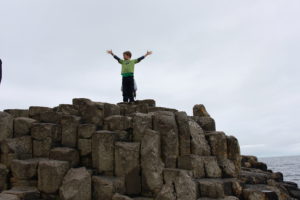
 

-My son Owen on a trip to The Giant’s Causeway in Northern Ireland in 2011.