How to navigate food at Holiday Parties

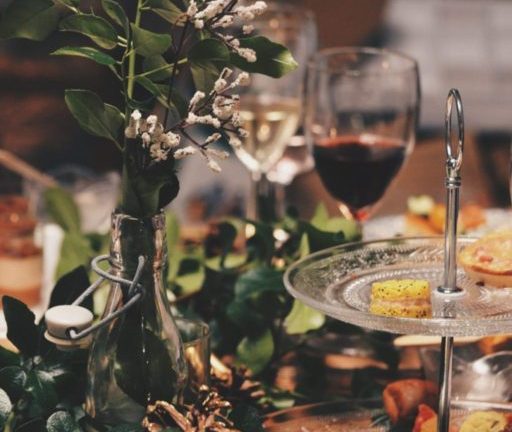
Holiday parties are the best and the worst. They’re the best because it’s fun to get dressed up and have fun together with family, friends, colleagues, and neighbors; and the worst because they can be a minefield in terms of food choices which can lead to potential weight gain and generally feeling unwell. There’s also bit of irony here because we are raising our glasses and toasting to our health!

Most food and drinks are not neutral. For the most part, what we consume either provides nourishment or contributes to some type of inflammation. During the holidays, there are so many tempting options, and they tug at our emotional strings because they are associated with comfort foods and childhood.

We need to remember that the tradition of feasting around the winter solstice originated in a time when it would be followed by a period of fasting in the barren winter months. The feasts would literally provide a chance to fatten up to survive the scarcity of food in the winter. Since we no longer suffer this scarcity, we no longer need to or desire to add more pounds in December.

It is well known for centuries and there is well-established research that sugar and starches are fattening foods. Given that’s what’s on the menu, it’s comes as no surprise that the average person in both the US and in the UK can expect to gain 5 to 8 pounds or more during the holidays. Its no wonder we are all forced into diets and detoxes in January.

With so many decadent treats, what’s the best way to get through the holiday parties? Maybe it’s time to break this cycle or at lease minimize the damage. Here are a few things to consider.

  1. One possibility is to eat before you go. Have a nice healthy meal with some protein and veggies before the party. You will be less tempted to nibble.
  2. Bring your favorite healthy holiday dish to share.
  3. Only eat if you are actually hungry.
  4. Avoid cocktails. Stick to dry wines and plain clear liquor and moderate consumption.
  5. Seek out the protein: nuts, meatballs, shrimp, cheese, kebabs, eggs, charcuterie, and such. These will be filling and provide nourishment.
  6. Crunch on the veggies instead of the crisps.
  7. Say no to processed foods and fried foods.
  8. Skip the bread basket. Just skip it.
  9. Avoid desserts that are both sugar and refined flour. Best options for sweets are fresh or dried fruit, cheesecake, custard, dark chocolate, or opt for the cheese plate. If you absolutely cannot resist, limit yourself to one or two bites and really savour them.
  10. Drink plenty of water to stay hydrated.

A few final tips:

  • There may be some events where you are just going to “go for it” and just enjoy without having to think about it. That’s great! Have fun and don’t go back regretting it later.
  • Have a buddy for accountability. Have pride in making best choices and not having to loosen your belt!
  • Don’t eat with abandon the entire month of December just because you already “blew it”. Enjoy the celebrations and scale back for other days and other meals. You will feel much better by the end of the month by enjoying the season mindfully.
  • Skip a meal occasionally. This is a perfect time to practice Intermittent Fasting to allow your body to recover form the indulgences.
  • Include movement in your days and get plenty of sleep.
  • Be present and in the moment and have fun!


Self-Care during the Holidays

The best way to enjoy the hustle and bustle of the holiday season week after week is to make a commitment to self-care and restorative practices. This is true all year, but especially true when the calendar is suddenly bursting with holiday lunches office parties, family gatherings; not to mention the assortment of traditions that must be adhered to. While it’s exciting and festive, it can also all feel overwhelming.

Restorative practices are ‘filling up the tank’ on the journey through this festive time of year and shouldn’t be considered optional. We must make opportunities to restore our energy to continue at the same pace or we will end up running on an empty tank. When a car drives faster or greater distance, it requires more fuel and more maintenance to carry-on or end up stalled in a ditch. Self-care preferences will vary from person to person. The one caveat is that they won’t work if you don’t do them!

Here are some tips to get through the season in stride:

  1. Mark it on your calendar just like any other commitment. You wouldn’t plan a trip without booking a place to sleep each night and some dinner reservations along the way. Don’t go through the holidays without booking yourself some time for restorative practices.
  2. Identify what works best for you to restore your energy and vitality. Do you like to snuggle up with a mystery novel and a cup of tea? Enjoy a bubble bath? How about meditation, journaling, a massage, working on jigsaw puzzle, playing music, or watch favorite TV with a family member.
  3. Do one thing at a time. Studies show that multi-tasking doesn’t really work and ends up taxing our brains even more in the process of shifting back and forth from one talk to another. The best way to make progress is to go through the list, focus one just one item, and then continue on to the next item.
  4. Stay positive. When you notice that your mood is shifting from the positive enjoyment of the season to feeling burdened, frazzled, or frustrated, that’s a sign that it’s time to schedule in some self-care.
  5. Say “NO”. Know yourself. Does socializing energize you or drain you? If you have more introvert tendencies and are exhausted after parties and big get-togethers, then protect yourself. Plan to make a brief appearance or don’t go at all. Find ways to connect with friends and family in smaller more intimate situations.
  6. Make gratitude a daily practice. Studies show that those with regular gratitude practice are more content with their present life situation. We don’t actually need all that stuff that the retailers tell us that we need anyway. Discover contentment in the present moment.

    Don’t bail on the basics: Sleep, diet, movement, stress management are essential.
  7. SLEEP – There is a natural tendency this time of year to more sleep as the nights get longer and darkness comes earlier. Allow for adequate sleep and even naps when there are a lot of nighttime events that interfere quality sleep. (Click here to read more about sleep.)
  8.  DIET – Ok, this one is super extra tricky during the holidays, but it’s really important. The challenge is magnified because the traditional treats that we enjoy this time of year are specifically related to the comfort and coziness that we feel and often trigger memories of delight from our childhood. (Click here to read more about holiday traditions.) As much as possible, choose nutrient dense foods with plenty of proteins. Avoid too many sweets and highly processed foods. I can’t sugar coat the fact that sugar is the enemy for optimal health and vitality. Consumption of sugar and highly refined products leads to inflammation, so don’t overdo it. Furthermore, since they share the same receptors in the body, when sugar is consumed, it hijacks the vitamin C absorption, weakening the immune system. (Click here to read more about the importance of Vitamin C.) Seasonal fruits like mandarin oranges, figs, and dates are a great way to enjoy some sweetness without contributing to the mal effects of sugary treats.
  9. MOVEMENT – An exercise routine is often the first to go when the going gets tough and the weekly schedule is filled up. You may not be able to manage a one hour zumba class, but don’t ditch it all together. Park further away from the front door and enjoy a longer walk to get the shopping done. Walk around the block after dinner or go for an ice-skating session. Hit the dance floor at the holiday parties. When at home, stand and do some arm circles, twists, jumping jacks when watching tv. Get creative and find a way to squeeze in a few minutes here and there whenever possible. (Click here to read more about movement.)
  10. STRESS – We all know by now that stress is bad, but it’s actually REALLY bad. When we are under continual stress, vital body functions like digestion and restorative sleep are put on hold and don’t work properly. Stress simulates an emergency and in order to allow the ability jump up and flee if necessary. Stress drains electrolytes and nutrients in the body very rapidly.  If you remain under continued stress with deadlines and expectations of the season, be sure you are getting enough electrolytes to support all of the body systems. (Click here to read more about electrolytes and best sources.) Maintaining restorative practices each week will further support reduction of stress levels.

Finally, while you are out and about enjoying the tasty offerings of the seasons, remember that the first restaurants were for travelers. The word restaurant comes from the French word restaurer, which means to restore. It’s simple and thrilling to dive into the variety of activities celebrating the holiday season. It’s also important to remember to refuel and restore ourselves so we can continue to sparkle.


Oh Autumn, a season to behold!

Life starts all over again when it gets crisp in the fall. – F. Scott Fitzgerald

Sweater weather, scarf season, pumpkin spice lattes, apple cider, scarecrows, cozy blankets, piping hot soup, scattered leaves, bold colors, blustery days – oh Autumn, a season to behold!

Autumn is a transitional season that encourages, and even requires us to be in the present tense. The nights become longer and cooler; and bit by bit the coolness drifts into the days. While it’s easy to long for the easy-going days of summer or think ahead to the upcoming winter and a big holiday season the enchantment really happens in the here and now because its so fleeting. Every day looks completely different. Look around and you will discover new colors, new dimensions and spaces appearing in the landscape. Harvests and rituals unique to the season insist that we pay attention or they pass us by. Back to school, pumpkin patches, persimmons, and cranberries come around only once per year; you snooze, you lose.

Autumn is bold and colorful and messy. It inspires feelings of coziness, melancholy, and nostalgia in one minute; and like any transition; discomfort, annoyance, and frustration the next. If summer represents fullness and carefree possibility, autumn begins to strip that away one day at a time. And unlike spring when we witness the adding to fill the void of winter, in the fall we are taking away. It requires that we reflect, let go, and move on. It almost seems “harder” than the other seasons, but it both tricks us and treats us into thinking otherwise because its all feels so magical.

All of this transition leads to transformation. Grapes are crushed into wine. Pumpkins are carved into jack-o-lanterns. Squash is roasted and puréed into soup. Pies and ciders and muffins and many treats are created from the bounty of apples. And with the harvest, the pruning begins allowing for a new cycle. It’s time to remove the blossoms that have wilted and the over-ripened fruit that has made the branches sag. The beauty is that despite the loss and the change in physical appearance, the essence remains. Just like all other life, we too must consider what needs to be pruned in our lives so that the best self can flourish in its essential beauty.

For many, autumn conjures images of leaves. On the coast of California, intermingled with the palm trees, there are a few token trees that change colors and shed. Now, living in the UK, I am experiencing the season on a whole other level with all of the senses. It is truly remarkable and proves that there is so much complexity to discover with fall. The leaves are fascinating for a variety of reasons. Obviously, they change colors and they fall, but that’s just the basics. The trees seem to have personalities and preferences. Some trees are early adapters. They got the memo. The leaves change colors and drop to the ground quite quickly. Some trees play it safe. They drop a few leaves, but plenty remain just in case it doesn’t work out. Other trees resist and linger. They are pretty comfortable with full branches, what’s the big rush? The wind plays a supporting role throughout it all alternating between steady breezes and angry gusts encouraging all towards achieving the ultimate purpose, going through the transition and leaving the bare landscape of winter.

It’s interesting to observe that the fallen leaves can never really be contained and freshly swept up ones are quickly dispersed by a sudden blast of wind. They swirl around on the front porch, they blow into hallways; they end up in odd places like under the sofa or in a shoe or a backpack and even on the train or in the car. Nature is going through it’s own release process, but the leaves never disappear all at once, they linger. Most of them eventually get cleaned up as winter sets in, but there are those sneaky ones that stick around in the garden and make themselves known long after they should have already been gone. It’s like the proverbial onion; as we release things in our life that no longer serve us, we peel away layers that keep coming back in different forms. Sometimes even disguised in a kaleidoscope of playful colors, like the leaves.

The falling of the leaves in autumn is far from a cut and dry process and teaches us that we should not expect that releasing things in our own lives would be either. It can take time and repetition to sever the wilted and over ripened areas that hinder developing into our best self. Enjoy this precious season one day at a time. Indulge and allow the process. When a blustery day knocks you off your feet, consider it a message that you may be holding on to something that’s weighing you down. It’s time to let go and shed what we no longer need. Take a lesson from the season and have fun with it, make that release a colorful and delightful celebration, and don’t forget the whipped cream and marshmallows on top!

Eckhart Tolle in London

The primary cause of unhappiness is never the situation, but your thoughts about it. Be aware of the thoughts you are thinking.
-Eckhart Tolle, A New Earth: Awakening to Your Life’s Purpose

It’s not often spiritual leader Eckhart Tolle turns up for a talk in London. When I found out about it, the show was sold out. Determined to attend, I checked back every day on the off chance that more would be released. I was rewarded during the second week with a standing only ticket up in the gallery of the Royal Albert Hall.

The four-hour ‘Awakening Consciousness’ event began at 5:30 on a stormy evening. Dark clouds had been accumulating and circulating around London throughout the afternoon. Any doubt of his connection to universal consciousness was released during the opening minutes when a massive thunder and lightning collided causing vibrations to ripple through the hall just as he just shared that, “the deeper dimension of consciousness is the greatest thing that can happen in your life.” Even in the warm, dry shelter of the grand scarlet painted hall, we were powerfully and dramatically reminded of the presence of Mother Nature.

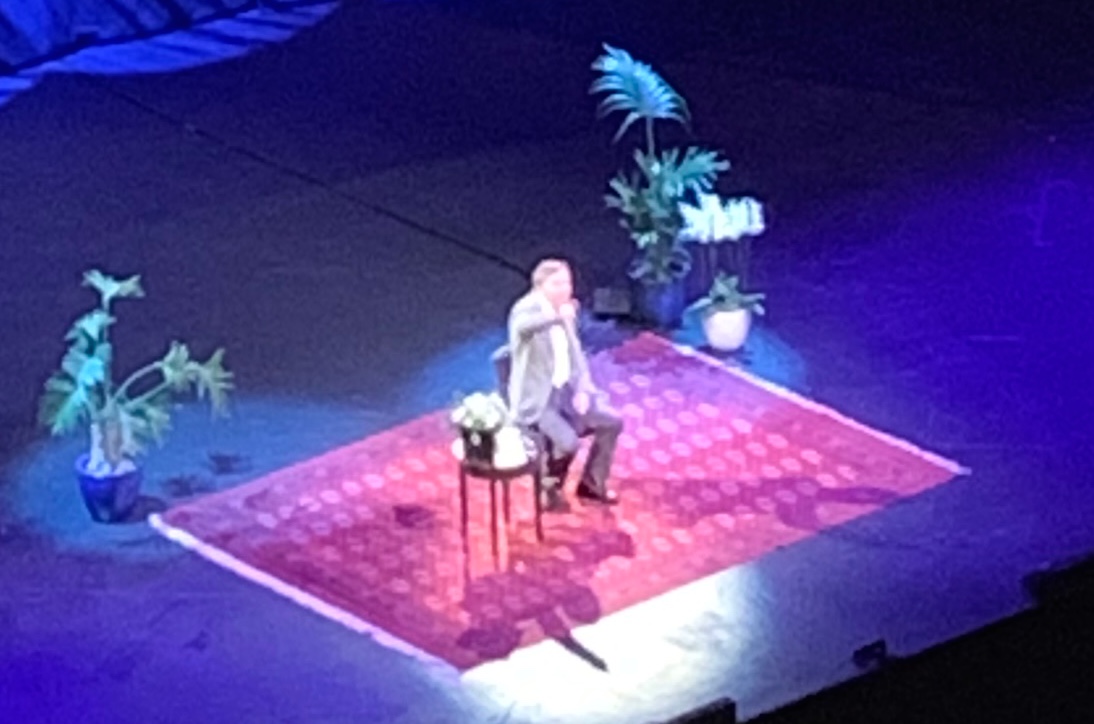
Eckhart Tolle sits simply at the center of the stage in an armchair, no reference notes, and just speaks as if a stream of enlightened consciousness is emanating through him. The sell-out crowd comes to a hush taking in and contemplating every word. He speaks slowly and pauses frequently allowing space to consider the deeper meaning of what he is saying. He portrays the idea of a space existing between words and between thoughts and forces us, the audience, to sit in the discomfort of that space on more than one occasion.

While he is serious about his purpose to lead others to a higher consciousness, he maintains a balance of wisdom and humor throughout the evening. For example, he recalled having attended a performance at the Royal Albert Hall when he was younger living in London. He mused that those seats way up in the hall and in the gallery provide a much greater perspective of the space. A laugh erupted from the crowd while those of us in the proverbial cheap seats (…if only there had actually been seats!) considered the alternate perspective of our physical location during the program. Even the humorous moments carried the thread of consciousness.

Always returning to the necessity to be and to live in the present moment, he conveys a message of universal spiritual themes such as the ego, compulsive behavior, and sources of unhappiness, enhancing the lessons with references and stories coming from Judaism, Christianity, Buddhism, mythology, Hindu philosophy, and ancient scholars. Maintaining consistency with his books, The Power of Now, and A New Earth: Awakening to your life’s purpose, the message spiraled through broad subjects in an attempt to provide a tangible explanation for something as intangible as consciousness.

“If you are trapped in a conditioned energy field you are condemned to perpetual dissatisfaction.”
Much attention focused on what he calls the “conditioned mind” and the “collective conditioned mind”. This is related to one’s dependence on external factors to achieve life satisfaction, and extends to the degree to defining one’s own identity by external markers. This can be anything from social status to material possessions to career achievements and the like. He suggests that what we have come to define as “the problems of our lives” exist in the mind and we become imprisoned by them. The real problem, he explains, is that we have become too attached to the thoughts and are conditioned to believe that those thoughts are the truth. The goal is to separate the thoughts and conditioned ideas from the reality of the present moment. The result will be a greater sense of ease in life by detaching from the thoughts and opinions that have been weighing us down.

“The situation did not create the unhappiness, it was the narrative about the situation that triggered you, put you in a state of reaction and at the mercy of the external situation.”
As he develops this theme, he uses the example of rain to clarify. Modern weather forecasting and conversations about the weather have led many of us to be conditioned to have an opinion about the rain, which will often be negative. Words like dreary, icky, dreadful, miserable, awful, grim, lousy, and so on are used to describe rainy days. Here in London when reading the Evening Standard distributed free to commuters as they head home after work, the weather forecast includes icons. A tidy pile of poop is the icon for a rainy day. But what if we take away all the judgment and conditioning about the rain? Then, it’s just rain. Ultimately, rain is as important to life as sun. The real problem is that we are carrying around preconceived notions about nearly everything we encounter and experience as we go about each day. One’s mind has been conditioned based on individual experiences, family situations, cultural, gender, and generational customs. These greater forces are considered extensions of the mind and also of what Eckhart Tolle calls, “the collective mind”. He warns to be careful with devices because they are an extension of the mind and have very addictive potential. We will become more conscious when we are able to recognize how our thoughts interact and interfere with the reality of the present moment.

During the midway point of the evening, we are all led through a thirty minute meditation by Eckhart Tolle’s partner Kim Eng. Already silent, we become still as we are instructed to close our eyes and focus on the breathing. As we enter deeper in to the meditation, we focus on various parts of the body while maintaining connection to the breath. Minute by minute there is a detachment from the mind. When the experience is complete, I am stunned that the time has already passed. I even check my watch to confirm that it had really been half an hour. I feel relaxed and peaceful with a shift in the perception of time. Following a brief intermission and Eckhart Tolle returned for the final segment.

“Become aligned with the present moment because that’s all you even have.”
Present moment practice involves perceiving the world around you without labeling the world around you. Just allowing things to be. Once there is a thought or a judgment it is very likely to attach to the ego where it will proceed on a tumultuous journey of the need to satisfy the appetite of the ego. He illustrates that Narcissus fell in love with himself and became very unhappy. The ego needs to feel superior. In this sense, any situation and thoughts about that situation create the potential to become possessed with a  sense of victim identity. This is incredibly toxic and will only lead to discontentment. Through awareness, one is able to transform worry, irritation, aggravation, anxiety, judgment, misery, and all this mental commentary to peace.

“Essence identity is not something you need to get, it just is.”
Eckhart Tolle discusses the “Deep I am”. Through meditation and awakening one discovers that consciousness is not something that you can “find” because is it already there. He describes most our lives as the ripple of a wave at the surface of the ocean that is reacting to its environment. That ripple is connected and one with the depths of the ocean and by going deeper there is stillness and peace. Babies and very young children are examples to us. A one-year old is simply aware and taking it all in. We all have the potential to connect to source energy and connect to the essence of self.

With his closing words, he thanks the crowd, stands briefly, and leaves the stage. As I make my way home on the dark, rainy night, I notice that yes, it’s raining, and really it’s just that, the state of the present moment.


21-Day Primal Challenge

It’s that time of year again that I feel ready for a reset. One of the keys to my sustained success with maintaining a healthy diet is by having periods throughout the year that I really focus on what I’m eating and paying attention to how my body is feeling. I used to do it just once a year in a longer chunk in January, but in recent years, I’ve been doing it several times a year for shorter periods of time. While a four-week or six-week program can seem daunting at the get-go, twenty-one days somehow feels a little more manageable and able to complete the course. The good news is that 21 days is long enough to make some changes in habits and be on the path to even bigger shifts toward your ultimate best self.

Let’s face it, we all know what we need to do and I know for me the more I spend focused time doing what I “should” be doing, the more that becomes the default in terms of daily choices related to food, movement, sleep, technology, and more. Knowing what to do isn’t good enough and isn’t going to give any results. What’s lacking for so many of us is DOING it. Have you been wanting to make some changes in your diet and lifestyle habits? Are you feeling sluggish after a long winter with plenty of comfort food? Want to feel fresh and energized for the long days of summer? Starting May 1, I’m offering a Free 21-Day Primal Challenge.

Join me for a Free 21-Day Primal Challenge starting May 1!

During the course of the 21 Days, you will receive daily emails exploring a variety lifestyle aspects including movement, diet, technology, sleep, stress, sunlight exposure, and  much more. You will learn the foundational tenants of Primal Health (aligns very closely with Paleo and also referred to as Ancestral Health). You will have an opportunity to see for yourself how this lifestyle supports our vitality and wellness based on science like biochemistry, molecular biology and nutrition; and is not really a “fad diet” after all. There’s a reason athletes, actors, CEOs, and celebrities and opting for primal, paleo, and keto diets (you’ll learn more about the nuances of these during the challenge.) Even the Queen of England is said to “sometimes go paleo”. While the Queen is not on a low-carb diet, she avoids starches when dining alone. “No starch is the rule,” said McGrady. “No potatoes, rice or pasta for dinner. Just usually something like grilled sole with vegetables and salad.” (Link to article here.

Truth be told, many years ago a close friend of mine was on a similar Paleo challenge with her gym. That got me curious. I went to the library and got a book to learn about it. Once I read about it, I decided that I couldn’t make all of those eliminations in my diet and I promptly returned it. As time went by, this diet kept coming onto my radar until eventually our family had some mental health issues that needed to be supported and we decided to give it a try. Fast forward to now, I’m certified as a Primal Health Coach and spent the last few years researching and learning why this works and how we can continue to improve our vitality each and every day. I have a vision to share what I’ve learned so others can experience to vast array of benefits available to us all.

This program reaches far beyond weight loss and I consider it to be a lifestyle program. This is about feeling good, feeling strong, reducing inflammation, clearing the brain fog, regulating a positive mood throughout the day, reducing stress, feeling rested, improved insulin sensitivity (potential to reverse pre-diabetes and T2 diabetes), improved memory, hormone regulation, healthy skin, improved GI function, reduced muscle and joint pain, and more. I won’t promise you will have all of this in 21 days, of course, but if any of these ring true for you, there is so much potential to support yourself with a nutrient rich diet and a more mindful perspective on daily routines of movement, sleep and other lifestyle habits.

Join me for a Free 21-Day Primal Challenge starting May 1!

In addition to the daily email message, you’ll be a part of a private Facebook Group to share experiences, ask questions, get recipe ideas, and know that you’re not alone in this challenge. This online community is a great way to both give and receive encouragement and accountability with others in the group. The group is private, so you’ll have the freedom to share within the group knowing that it’s a safe space to share both successes and also challenges. Many participants have found that they often same the same struggles and support each other to work through the tough patches. Most importantly, it’s a place to show up for yourself and participate with others. I’ll be posting some of my favorite recipes in addition to how to navigate restaurants and social occasions and answering any questions that you have.

Join me for a Free 21-Day Primal Challenge starting May 1!

Here’s what others are saying about the 21-Day Primal Challenge:

“I was surprised at how easy it was to follow the primal challenge. I like carbs, sugar, and wine, but once I made it past the first several days, my body responded and I found it easy (mostly!) to make healthy choices. Sheila’s support and the bite-sized chunks of information meant that I wasn’t overwhelmed up front. It was great to be able to share tips with the Facebook community too. After the 21 days, my stomach felt noticeably less bloated and I had lost several pounds. I felt energetic and unlike other challenges, I wasn’t eager to go back to my old eating patterns because I felt better!”
-Sara, Graduate Student

“I was skeptical at first to try yet another diet…until I lost almost 5 kilo during Sheila’s 21-Day Challenge. I found Primal Health to be an inspired nutrition and lifestyle behavior program that’s easy to slot into your life without drastically changing your daily routine. I’m very grateful for how Sheila has transformed my way of thinking about food by suggesting recipes, menu ideas, and ways to navigate all my food allergies. The best part: I’ve kept the weight off.”
-Susana, Financial Advisor

“I really appreciated this challenge.  I was not able to do it exactly as suggested, but it did give me new ideas for what to eat and how to exercise.  I liked having something new to try every day.  It kept my mind on my health.”
-Christina, Special Education Teacher

Join us for the challenge starting May 1. My goal is to our biggest group to date and spread the health far and wide. Your body is your vessel for all of things that you love to do in life, and it’s amazing how good you can feel when you are acting on what you already know to be the “right thing to do”. It’s a process and by joining me for 21-days, you’ll have some great tools to be more mindful about so many parts of your daily life that contribute to your overall well-being. Furthermore, this may be the last time that I’m offering the challenge for Free, so if you’ve been thinking about joining, now is the time. To sign up, click on one of the links, or complete for form included below.

Finally, if you know someone who would benefit or be interested in this program, please pass this on so they will have the opportunity to sign up too. Even better, consider doing the challenge together with a friend or family member. You’ll have each other and the Facebook group for an abundance of support and accountability.

[ctct form=”516″ show_title=”null”]
Out of hibernation

OK, I confess, I’ve been in full-on hibernation mode. The irony is not lost on me that the topic of my last post of Winter Solstice and here we are having just passed the Spring Equinox. An entire season has passed! Not that I didn’t have good intentions or ideas or inspirations, it was simply hibernating and it just happened. I adore the seasons and they have so much to teach us. To be honest, while I was walking around in awe of the discreet beauty of winter and drinking pot after pot of tea to keep warm, I also felt lazy, undisciplined, and even guilty. Would I think that about a tulip bulb or a lilac bush or an oak tree? Can you imagine the rare critter scattering about looking at an oak tree in January and thinking, “I can’t believe how unproductive you are right now, what a lazy lump!” But what is there really to do when the sky is dark and the ground is cold? Just be. Have patience. Trust that light and warmth will return. Full trees and colorful blossoms would look out of place in a winter landscape. It would be forced and unnatural. To everything turn, turn, turn, There is a season turn, turn, turn, And a time to every purpose, Under heaven.

A few years ago I had the privilege of attending a David Hockney exhibit in San Francisco. He had moved from Los Angeles back to England and spent several years capturing the same landscape scenes during each season in a variety of mediums. I felt so much emotion at this exhibit because it captured the nuances and unique beauty of each season. When it was on display with all the seasons together it was so complete and stunning.

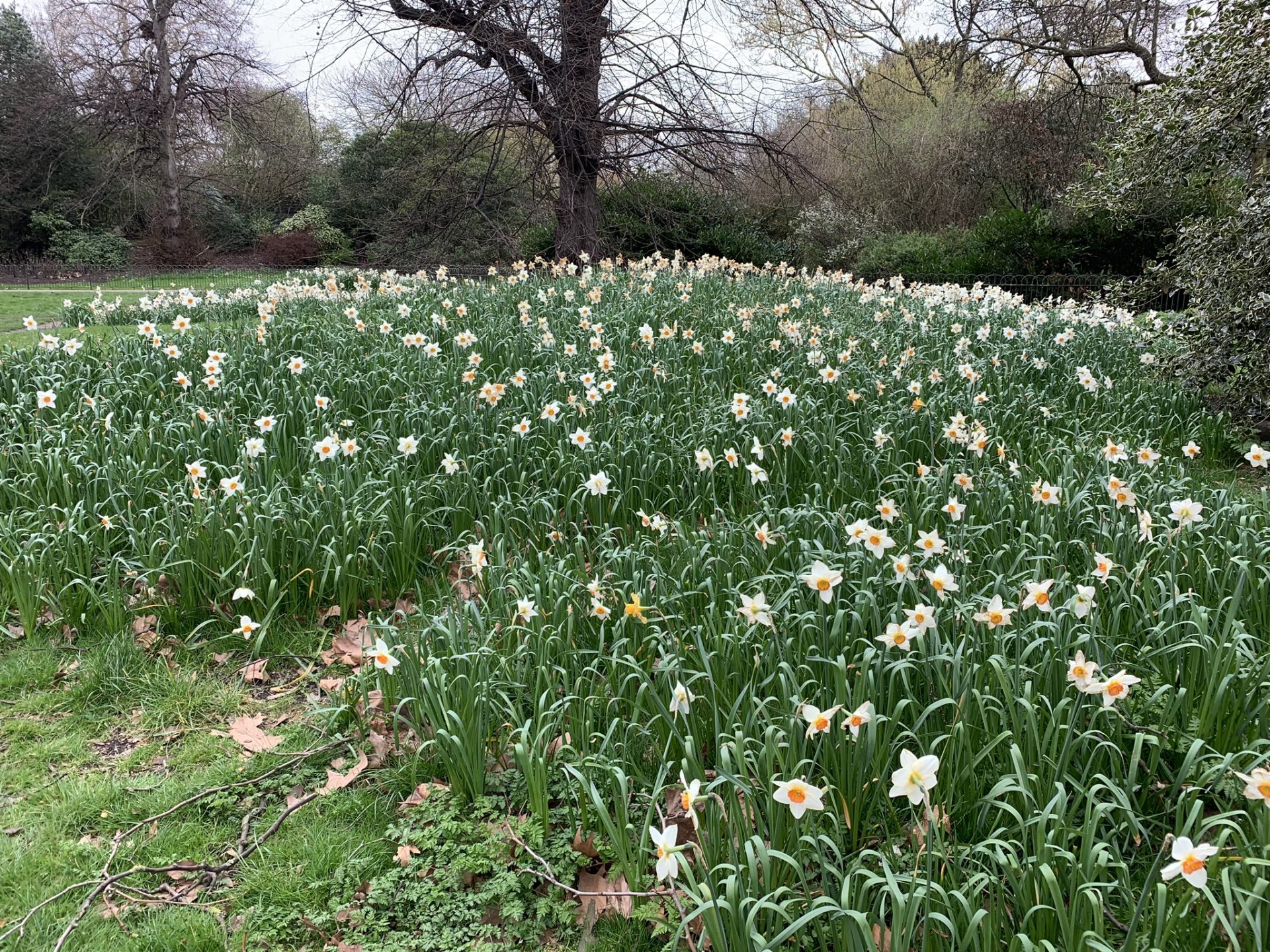
Like Hockney, I spent decades on the California coast, famous for its mild, stable weather and lack of seasons, and recently moved to England. In less than eight months, experiencing proper seasons has been one of my greatest joys living here. I wasn’t sure how I would find the winter being colder and darker than I was accustomed to. Surprisingly, I found it very beautiful in understated ways, tranquil, pensive, steady, and predictable. But not entirely: very subtly almost without notice, the days start getting a little longer each week, a little warmer. One morning, the birds are singing and another morning daffodils are sprouting up and offering the welcome gift of color. A few days later, the bare trees start to fill in with buds, tiny at first and then growing bigger each week until the first leaves pop out. Our senses gradually start to adjust to the sounds and colors of life where there has been none. It signals us to become alive too. The change of scenery reminds us that its time to show our vibrant colors and to begin the process of growing to our greatest heights and be filled with the warmth and energy of the sun and our surroundings. It reminds us that it’s time to leave behind the sleeping, introspective, quietness of winter and be grateful for the time of rest and renewal and recharge.

We all need periods of winter in our lives. Unfortunately, calm, still, thoughtful, and dormant are most often not valued characteristics in modern life that instead prefers high energy, productivity, and activity all the time incessantly! It’s not sustainable because it’s out of balance. It becomes forced and unnatural, it’s not complete. I encourage everyone to honor the season that you find yourself in in various areas of your life and allow the beauty and magic of each season run its course. If you’re feeling the spring energy like I am, what seeds will you be planting now that the ground has thawed? How high will you fly? How full will you grow? Will you take a class? Travel to a new place? Try a new recipe? Spend more time with friends and family? Do you need to allow yourself to be reflective and serene and have a winter season that you may have missed? Most importantly, how have you been hibernating? What parts of yourself have been dormant and need to come back to life? Happy spring! May you be filled with energy and vitality and may blossoms flourish in your life!

How good are you at being yourself?

That’s an interesting question. Brené Brown says, “Our sense of belonging can never be greater that our level of self acceptance.” But where does our sense of belonging come from? It seems like everywhere we turn we are bombarded with messages that we need to be more organized, be more fit, have tighter abs, eat healthier foods, have shinier hair, have a more balanced life, be a better parent, look younger, work harder, and it goes on and on and on. But really, who says? And what is the metric for better, healthier, shinier, and nicer? And more importantly, what are these messages doing for our kids?

I wish I had the answers to these questions, but I believe they are important ones to consider and discuss them. When I was younger I loved reading magazines and keeping up with the latest fashion and make-up styles and such. Then came a time a few years ago that I just felt icky when I read those headlines and magazine articles. They made me feel unworthy and killed any good sense I had of myself. What happened?

It’s a tightrope walk undoubtedly. We better ourselves by making goals and staying committed to improve our lives and ourselves. And sometimes I think our goals get distorted too. It’s so easy to strive for something that doesn’t exist and that can get confusing for adults and young people alike. A friend of mine went to a workshop with her teenage daughter. They ended up looking through women’s magazines cutting out anything that they liked and were inspired by – lips, eyes, shoes, clothes, hairstyles, and more. At the end, each girl had a collage of her “perfect image”. The problem was that the end result was the eyes of one person, the hairstyle of another, lips, butt, and fashion style all from unique individuals. That one person who has it all does not exist. It’s more than a good reminder to reflect on the nature of our goals and whether they are outwardly or inwardly oriented.

To make matters worse, we tend to focus on faults more than talents. This is a deficit perspective and can become a dangerous obstacle blocking the way of living to our highest potentials. What happens when a child has all A’s in school (even an A+ in English or History) and a B or C in math for example. Many kids in high school will be referred to a math tutor because they need to get good grades in math. I heard a story recently that put it all into a new perspective. Take the same story and apply it to sports. Imagine a kid that’s really good at basketball and just ok at baseball. Do we go out and get extra baseball coaching? No! We provide enrichment and support to make him or her even better and in pursuit of excellence at basketball. I love this example because it really demonstrates how perverse our perspective and dialogue can be. Where are you putting energy into deficits rather than building on what you are already good at? And if you have children, what does that dialogue look like? It’s so easy to compare ourselves to an unrealistic ideal rather than accepting and celebrating what we are really good at and acknowledging growth and improvements at our own personal pace.

Our son has had significant behavioral and mental health challenges. He does not fit into any of the boxes available to children in our “tidy” society. I have researched and tried so many things to “help” him and support him. He’s my son, I’ll do anything for him and I want the best possible outcome for him. But what if we are all trying to hard to make him “fit”? It’s a question that I ask myself often. It’s not easy when everything around me is screaming that kids are supposed to be a certain way and it must be the family’s fault or the parenting or lack of discipline or whatever when a child doesn’t turn out to the perceived metric of success. Maybe kids like this are delivering an important message to us. My son is good at being himself. And the best question I can ask him each day is, “How were you your best self today?” That also means that when some kind of incident happens, I need to experience it with a different lens. I’ll be honest here, I miss this mark A LOT. It’s so easy to default to being upset and getting back to “fixing” him. Then I realize that while the outburst was unpleasant (maybe even VERY unpleasant), if there hasn’t been one for a few weeks, then that may actually be a huge improvement from 5-6 times per day a few months ago. It all depends on which perspective I take.

When I flip the lens back to myself, I am also guilty of measuring myself to idealistic expectations and values that are not my own and that have been imposed on me. I stopped reading those magazines that give me the message over and over again that I am not good enough. I’m learning what I’m really good at and investing in getting better. This requires a lot of grace and compassion. There are endless opportunities to practice that too! The best way I have found to move forward is to set an intention to be my best self each day with the realization that my best self will be different from day to day. So instead of all the other questions we can reflect on and measure ourselves at the end of the day, maybe the best one is, “how were you your best self today?”

Summer Solstice Rituals

When this is published , I will be backpacking in the Alaskan wilderness. And lucky for me, our trip will be during the summer solstice, the longest day of the year. In Alaska and other places in the northern latitudes, that’s a very long day with the days often blurring into one another! I couldn’t be more excited about this trip that we have been planning for a while now.

The summer solstice represents a time to be open and receive all the goodness that the universe has to offer. We celebrate the abundance of light to extinguish our doubts and fears and burdens. It’s a time to open our senses and notice possibilities that we may not have noticed before. The day marks the halfway point of the year, making it a perfect time to for a mid-year reflection to assess if we are heading in the right direction or if we somehow ended up on an unexpected detour. It’s a time to consider what hasn’t been working and release it; and a time to decide what we want more of in our lives and declare the intention to create just that.

The solstice is believed to have been observed by humans as early as the Stone Age, and many cultures continue to celebrate the occasion with rituals such as special meals, bonfires, dances, and songs.

You may already have your own tradition. I was in Sweden one year and we ate herring and potatoes and had big picnics during solstice week, which is also known as midummer. There are big events at Stonehenge and other Pagan sites each year to commemorate the day. If you don’t have on already, I encourage you to consider starting or trying out a Summer Solstice Ritual for yourself this year. Fill yourself with the gift of abundant light and energy that this extraordinary day offers to us each year.

Here are a few ideas:

  • Take some time this week to acknowledge everything that you have done so far this year and have gratitude.
  • Reflect and anything you are ready to release in your life. Write it down on a piece of paper and then burn the piece of paper.
  • Host a gathering with friends and experience the positive energy increasing.
  • Light some candles and take a bath. This is a great bath recipe for summer solstice:
    • 1 cup Epsom salts
      1 cup Himalayan pink Salts
      1 cup sea salt
      3 drops wild orange essential oil
      3 drops neroli essential oil
      2 drops ginger essential oil
      2 drops basil essential
      1 drop clove essential oil
      Soak in warm bath in a quiet peaceful environment for 20 minutes or more. Take deep breaths and visualize releasing your burdens and receiving joy and love and all the gifts of the universe for added effect.
  • Watch the sunrise and spend as much time as possible outside basking in the warmth and the light from the sun.

What other rituals do you have? Please post in the comments and we will all add to the list of possibilities.

Happy Solstice!


Jigsaw Puzzles and Life

I really enjoy doing jigsaw puzzles. I don’t do them nearly as much as I would like to, but once or twice a year, I dump a bunch of pieces onto a card table and give it a go. A few weeks ago I started on new one of a beautiful peacock and all the colorful and intricate feathers. This time I became very observant and engaged in the process of completing the puzzle. I was surprised by the lessons that came from it that are applicable to most things in life.

Observe and consider a plan. From the beginning, it can be overwhelming to see the 500-1500 pieces scattered around on the table. Some of them upside down and everything all mixed up. Life feels like that sometimes with all the pieces scattered and nothing seems to make sense. The only thing to do at that point is to observe and start to consider a plan. The first step is to get all the pieces turned right side up. Once that happens there is a simple set of steps that takes place until the puzzle is complete. Click here to see my steps to solving a jigsaw.

Trial and error leads to success. I like to think I’ll sit down like a boss, have a look at the pieces, and then be able to easily place them in the proper places. This never happens. In fact, the more trial and error that I’m willing to do at each session, the more progress I’m likely to make in the long run. It is necessary to find out where the pieces don’t fit in order to eventually figure out where they do belong.

Progress is progress no matter how small. I work in 5-25 minute chunks when passing through the dining room or when I am in transition of activities or waiting for the dinner to bake in the oven. Sometimes it all goes smoothly and easily and lots of pieces get connected and just seem to fall into place. Other times, I just can’t see it. I just can’t find the right pieces and nothing that I try works. That is so frustrating and then, I spend longer than expected trying more and more pieces. It’s just at those points that I get the greatest satisfaction from fitting just one single piece into place. That’s when it’s all been worth it for that session and I can now move on.

Allow others to pitch in. While this remains mostly my project, it does attract other members of the family as well. There tend to be few days that are super busy and I feel discouraged that I haven’t been having any sessions at all and my progress has come to a standstill. I am very pleased to finally get back to it and discover that someone has sat down and worked though an entire section that has alluded me. In fact, it gives me a huge boost in motivation and makes me feel both connected and supported.

We have all the right pieces, but their placements may be yet to be revealed. For a more complicated puzzle it requires looking at a lot of detail of each piece: the size of the piece, the orientation of the shapes, and the colors on the surface. At some point it actually becomes possible to notice a piece upon scanning and pick it up and put it perfectly into the exact spot that is belongs. When that happens, it feels oh so good! Interestingly, the last 782 times that I scanned that same piece I had no idea where that specific piece belonged. This is partially because the more time I spend with the puzzle the more intimately I know each piece and its unique possibilities. More importantly perhaps is the fact that placing certain pieces only becomes possible after other parts of the puzzle are complete to reveal the placement for the pieces to come. If I were to become stuck on finding a spot for one specific piece, it would be impossible to finish. It makes me wonder what things in my life I may be trying to force into place when maybe I just need to be patient and work on what makes sense in the moment.

Unexpected things will happen. Someone may accidentally knock the table over causing much progress to be lost. A naughty member of the family may hide a few pieces and will eventually put them back. A sneaky piece may have been stuck in a folding of the box. A beverage could spill all over the whole thing. You get the idea. Unexpected can literally mean anything. The only thing to do at this point is keep at it. Do the detective work for the missing pieces, pick up the scattered pieces, clean up any other mess, and get back to it.

Effort will be required until the very end. As I continue to observe the process, I am nearly finished and I think that the end will be super easy and I will just coast through the final dozen pieces. That is far from the truth. The final pieces are the most mysterious and tricky. They require the closest look and the most manipulation as if they are teasing me with their cleverness. It requires that I focus on the purpose that I have to fulfill and have the tenacity to keep on working those pieces up until that last piece has been put into its place.

The pleasure is in the process. And alas, the puzzle is complete! It’s so satisfying; I pause and remain still, staring at the final product in all it’s glory that came together after several days and many, many sessions. I feel a sense of achievement and pride at the accomplishment. Surprisingly, there is an emptiness too, a mourning of a process that is complete. I leave the finished product on the table for a few days and whenever I walk by I stop to admire it. Underneath it all, I would be just as pleased to sit down and work through some pieces and make some progress. With that desire, I clean it up and start on the next project, a new process, and new lessons.