21-Day Primal Challenge

It’s that time of year again that I feel ready for a reset. One of the keys to my sustained success with maintaining a healthy diet is by having periods throughout the year that I really focus on what I’m eating and paying attention to how my body is feeling. I used to do it just once a year in a longer chunk in January, but in recent years, I’ve been doing it several times a year for shorter periods of time. While a four-week or six-week program can seem daunting at the get-go, twenty-one days somehow feels a little more manageable and able to complete the course. The good news is that 21 days is long enough to make some changes in habits and be on the path to even bigger shifts toward your ultimate best self.

Let’s face it, we all know what we need to do and I know for me the more I spend focused time doing what I “should” be doing, the more that becomes the default in terms of daily choices related to food, movement, sleep, technology, and more. Knowing what to do isn’t good enough and isn’t going to give any results. What’s lacking for so many of us is DOING it. Have you been wanting to make some changes in your diet and lifestyle habits? Are you feeling sluggish after a long winter with plenty of comfort food? Want to feel fresh and energized for the long days of summer? Starting May 1, I’m offering a Free 21-Day Primal Challenge.

Join me for a Free 21-Day Primal Challenge starting May 1!

During the course of the 21 Days, you will receive daily emails exploring a variety lifestyle aspects including movement, diet, technology, sleep, stress, sunlight exposure, and  much more. You will learn the foundational tenants of Primal Health (aligns very closely with Paleo and also referred to as Ancestral Health). You will have an opportunity to see for yourself how this lifestyle supports our vitality and wellness based on science like biochemistry, molecular biology and nutrition; and is not really a “fad diet” after all. There’s a reason athletes, actors, CEOs, and celebrities and opting for primal, paleo, and keto diets (you’ll learn more about the nuances of these during the challenge.) Even the Queen of England is said to “sometimes go paleo”. While the Queen is not on a low-carb diet, she avoids starches when dining alone. “No starch is the rule,” said McGrady. “No potatoes, rice or pasta for dinner. Just usually something like grilled sole with vegetables and salad.” (Link to article here.

Truth be told, many years ago a close friend of mine was on a similar Paleo challenge with her gym. That got me curious. I went to the library and got a book to learn about it. Once I read about it, I decided that I couldn’t make all of those eliminations in my diet and I promptly returned it. As time went by, this diet kept coming onto my radar until eventually our family had some mental health issues that needed to be supported and we decided to give it a try. Fast forward to now, I’m certified as a Primal Health Coach and spent the last few years researching and learning why this works and how we can continue to improve our vitality each and every day. I have a vision to share what I’ve learned so others can experience to vast array of benefits available to us all.

This program reaches far beyond weight loss and I consider it to be a lifestyle program. This is about feeling good, feeling strong, reducing inflammation, clearing the brain fog, regulating a positive mood throughout the day, reducing stress, feeling rested, improved insulin sensitivity (potential to reverse pre-diabetes and T2 diabetes), improved memory, hormone regulation, healthy skin, improved GI function, reduced muscle and joint pain, and more. I won’t promise you will have all of this in 21 days, of course, but if any of these ring true for you, there is so much potential to support yourself with a nutrient rich diet and a more mindful perspective on daily routines of movement, sleep and other lifestyle habits.

Join me for a Free 21-Day Primal Challenge starting May 1!

In addition to the daily email message, you’ll be a part of a private Facebook Group to share experiences, ask questions, get recipe ideas, and know that you’re not alone in this challenge. This online community is a great way to both give and receive encouragement and accountability with others in the group. The group is private, so you’ll have the freedom to share within the group knowing that it’s a safe space to share both successes and also challenges. Many participants have found that they often same the same struggles and support each other to work through the tough patches. Most importantly, it’s a place to show up for yourself and participate with others. I’ll be posting some of my favorite recipes in addition to how to navigate restaurants and social occasions and answering any questions that you have.

Join me for a Free 21-Day Primal Challenge starting May 1!

Here’s what others are saying about the 21-Day Primal Challenge:

“I was surprised at how easy it was to follow the primal challenge. I like carbs, sugar, and wine, but once I made it past the first several days, my body responded and I found it easy (mostly!) to make healthy choices. Sheila’s support and the bite-sized chunks of information meant that I wasn’t overwhelmed up front. It was great to be able to share tips with the Facebook community too. After the 21 days, my stomach felt noticeably less bloated and I had lost several pounds. I felt energetic and unlike other challenges, I wasn’t eager to go back to my old eating patterns because I felt better!”
-Sara, Graduate Student

“I was skeptical at first to try yet another diet…until I lost almost 5 kilo during Sheila’s 21-Day Challenge. I found Primal Health to be an inspired nutrition and lifestyle behavior program that’s easy to slot into your life without drastically changing your daily routine. I’m very grateful for how Sheila has transformed my way of thinking about food by suggesting recipes, menu ideas, and ways to navigate all my food allergies. The best part: I’ve kept the weight off.”
-Susana, Financial Advisor

“I really appreciated this challenge.  I was not able to do it exactly as suggested, but it did give me new ideas for what to eat and how to exercise.  I liked having something new to try every day.  It kept my mind on my health.”
-Christina, Special Education Teacher

Join us for the challenge starting May 1. My goal is to our biggest group to date and spread the health far and wide. Your body is your vessel for all of things that you love to do in life, and it’s amazing how good you can feel when you are acting on what you already know to be the “right thing to do”. It’s a process and by joining me for 21-days, you’ll have some great tools to be more mindful about so many parts of your daily life that contribute to your overall well-being. Furthermore, this may be the last time that I’m offering the challenge for Free, so if you’ve been thinking about joining, now is the time. To sign up, click on one of the links, or complete for form included below.

Finally, if you know someone who would benefit or be interested in this program, please pass this on so they will have the opportunity to sign up too. Even better, consider doing the challenge together with a friend or family member. You’ll have each other and the Facebook group for an abundance of support and accountability.

[ctct form=”516″ show_title=”null”]

Support your family’s mental and physical health

11 ways to help kids reduce sugar and processed food

Deep down it’s something we know we should do. Reducing sugar and refined carbohydrates sounds like such an easy, quick fix. In reality it’s often a challenge that we don’t even want to face. Kids love sugar and we love that smile on a child’s face when we give them a treat like a cupcake or a lollipop. As we learn more about the affects of sugar on our health, all those little treats become less and less sweet after all.

Most people think of sugar and processed carbohydrates it evils contributing to obesity, diabetes, and cavities. Did you know that these substances also influence mental health? For decades, obesity was a risk factor for so many diseases, that much research tended to get stock on obesity and weight loss. There is now much research and evidence that the same items that are promoting obesity are also responsible for mental health challenges.

Given what I have come to learn about sugar and carbohydrates from the likes of Dr. Robert Lustig, Nina Teicholz, Gary Taubes, Dr. David Perlmutter, and Drs. Jeff Volek & Stephen Phinney; it comes as no surprise to me that we are in a mental health crisis in parallel with what is being called the obesity epidemic. In our own family, we tried many interventions, therapies, and medications to help our son regulate his moods and support his mental stability. Interestingly, we only came to consider dietary  changes when he was rapidly gaining weight due to a side effect of his psychiatric medications. I now believe that dietary consideration should be one of the primary interventions when mental and emotional health concerns arise.

Based on my research, we decided to go on a keto (ketogenic) diet within the framework of the Primal Diet. Primal is very similar to Paleo with the main difference being that dairy is very individual and allowed when it’s tolerated. Not that it makes it any easier with the elimination of all grains and legumes including wheat, rice, beans, and everything that falls into that category. The reason for this elimination is because grains are high in carbohydrates and carbohydrates spike insulin and blood sugar levels. Once insulin is activated there tends to be a tendency for cravings of more carbohydrates and the goal is to break this cycle. In order to regulate mood and weight, blood sugar levels need to be stabilized. According to research, ketogenic diets and very supportive of brain health and also contribute to reaching an ideal body weight. If this is going to be too big a jump for your family, I suggest aiming for eliminating sugar and processed foods and greatly reducing gluten. This will still allow for other grains like rice and oatmeal as well as legumes like beans and lentils.

Our son gave up sugar and carbohydrates more for a period of time starting on his 11th birthday. Often when I tell this story, I get remarks from many wishing their child or teenager would eat better and consume less sugar and junk food.  It seems nothing short of a miracle that it actually worked given how much 1 – kids love sugar, 2 – how addictive sugar is, and 3 – sugar-laden and processed foods are heavily advertised to children, are cheap, and are everywhere.

The whole experience opened up a lot of conversations not only about healthy choices, but also about how specific foods are nourishing to our bodies and brains. By eating for maximum nutritional density, we have found that we are not compromising flavor or satisfaction and we feel great because we are nourishing our bodies at a cellular level. 

How did I do it? How did he do it? It was more like how did WE do it. Here is our TOP 11 list of how we made this a successful dietary switch.

#1 – Do it as a family. I completely changed the composition of our family meals. While some family members indulged more out of the house, at home, there was a reliable amount of tasty, acceptable food. We ate family meals just as we always had, the only difference was that I was tweaking the contents of the dishes that I served by eliminating sugar and refined carbohydrates.

#2 – Make a plan and offer alternatives. Anyone who has tried to change a habit knows that it will only work if you have a replacement ready for what you are trying to avoid. We leaned in on very high fat items to produce satiety and replace sweet, high-carb items. Along with breakfast, I would serve a small glass of heavy cream sprinkled with cinnamon. For dessert, there would be a bowl of whipped cream or some brie cheese.  In the short term some processed meats were deemed okay since we were trying to break the sugar habit. Slices of pepperoni, a handful of nuts, and a few carrot sticks became the low-carb afternoon snack.

#3 – Guided choice. Choice sounds a lot like alternatives, but guided choice actually quite simple. When a child is following a diet, it’s easy to feel discouraged by lack of control. By offering choices, the child feels like s/he is in control of the decision. Scrambled eggs or fried eggs? Cheddar or pepper jack cheese? Macadamia nuts or walnuts? Turkey or salami? Tomatoes or celery?  Attention to this detail can be a game changer!

#4 – Stick to what’s familiar. Eat bacon cheeseburgers without the bread, meatballs with marinara sauce sans spaghetti, or taco night without the tortilla. By keeping things familiar there is less sense of depravation and more chance of sticking to the changes.

#5 – Understanding and ownership. I believe the biggest reason that our son continued to follow this diet was because he had ownership of it and he understood how it contributed to his mental and physical well-being. Even if we don’t tell them directly, kids know when they are gaining too much weight or have bad behavior. Educate them about why reducing sugar will help with behavior and help them to grow at a steady rate. Given that he loves data, we kept track of his height and weight on the growth chart from the pediatrician and were thrilled when he moved back into the range of the normal after having moved into the overweight zone as weight gain was a side effect of his medications.

#6 Designate acceptable treats and when they will be consumed. By deciding ahead of time what kinds of treats are acceptable, it takes away the stress and the need to have will-power when making a decision. We keep treats to a minimum during the week. We have some allowances during the weekend as long as the items are high in fat to balance out for the sugar load. For example, ice cream, cheesecake, pudding, and dark chocolate are acceptable in moderation. We tend to avoid conventional cakes and cookies that have both sugar and white flour. Candy is also off-limits because it is made of pure sugar. Experiment with some new recipes with alternative ingredients. There are many readily available online.

#7 – Offer incentives. One Saturday during the first month that we ditched the sugar and carbs, we went to a birthday picnic with a giant supermarket birthday cake.  I offered him a $10 itunes gift card if he would say “no thank you” to the cake. I didn’t want to tell that little boy “you can’t eat that”, but I also really didn’t want him to eat it so I tried to come up with something that would be easy for him to accept. In this case, it was a no-brainer and he chose the gift card!

#8 – Eat when you are hungry and no calorie restriction. Within the acceptable food items that were high in fat and full of protein, unlimited consumption was allowed. It is very unlikely that someone would overeat these foods. Have you ever eaten too many pork chops or too much frittata? It doesn’t really happen, you stop when you are no longer hungry. It’s a good rule to follow! Once sugar and carbs enter the picture, everything changes and it’s much harder to stop eating sometimes.

#9 – Try new things. This sounds contrary to #4 and sticking to the familiar, but in fact they need to work in tandem. The familiar helps the change feel less overwhelming while trying new things keeps it from getting boring. If trying new things is difficult for your child, start by adding new side dishes instead of main courses. Better yet, let them choose a recipe from an approved (i.e. paleo or low-carb) cookbook and then make whatever your child chooses.

#10 – Plan ahead for unknown situations. Pack appropriate snacks. Check the menu at restaurants ahead of time. Carry emergency rations so you won’t be tempted to grab something in a rush that will most likely end up feeding a craving. Find a list of appropriate substitutions and keep those ingredients on stock in your pantry and refrigerator.

#11 Educate and learn together. This has been an opportunity for us to learn about brain development, biochemistry, cooking and more. We are constantly learning about how to best nourish our bodies and brains and sharing new information and recipes with each other.

It does pay off to have a strict elimination of sugar and processed foods for some time (21 days or more) and enjoy the benefits which will often include more stable energy, regulated moods, weight loss or easy weight maintenance, reduced cravings, better control over insulin and blood sugar, reduced inflammation, and even enhanced cognitive performance.  Once new habits and patterns are created, it’s easier to relax. There comes a point of gaining awareness about how you feel when eating various foods and that’s valuable feedback to stick to it. We all want to feel and perform our best and once we realize the effects and potential damage, it’s much easier to default to choices that improve our health and quality of life rather than the old stand-bys that offer little more than a sugar hit.

As a result of dietary changes, we have been able to steadily reduce our son’s medication support and he is tracking to be complete off his meds by summer of this year.  It did not happen overnight and was only achieved by staying the course committed to those choices day after day and week after week. A few years have passed now and we are not as strict as we were in those first months. We have more flexibility with the foods that we have in moderation, but we still strive to keeps processed foods, refined carbohydrate and sugar in check. We focus on the positive and do our best every day. I think the goal ultimately is to learn what foods support each one of us and that is often very unique to each individual.

Ultimately, these ideas are all interconnected. Initially, making this transition is challenging because our culture tends to offer junk food both as incentives and for celebrations, even at school. Make a plan and get started one day at a time and experience the results. There will be some bumps along the way and it will require focus in the beginning because change is hard, but I encourage you to move out of your comfort zone and default habits and stay on the course to change and reap the restorative health rewards of a nourishing diet.

The real reason you (and I) eat the whole bag of chips

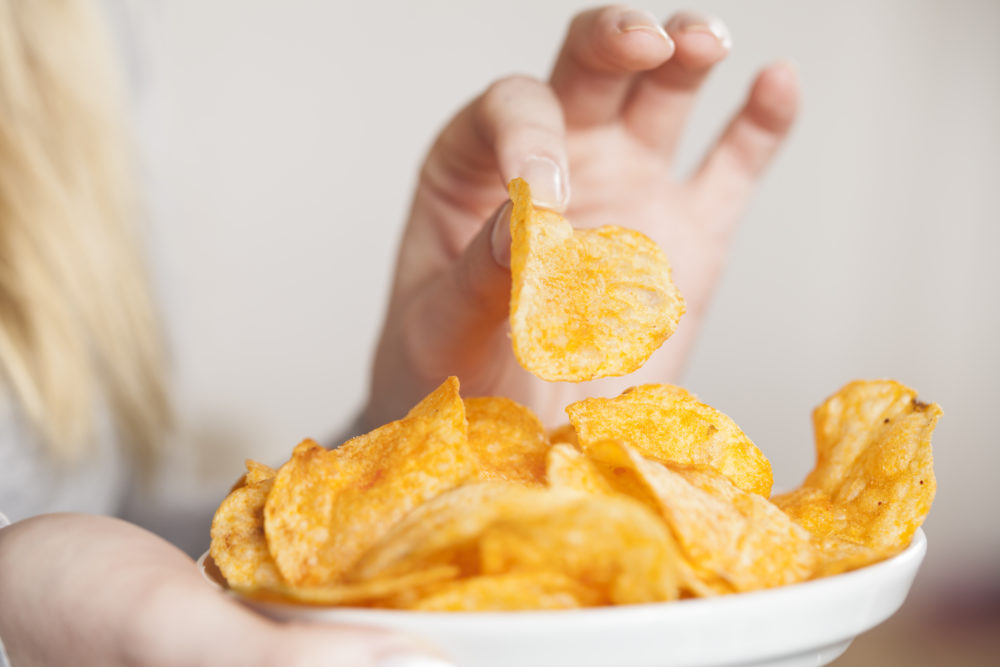
Summer is here and so are the graduation parties and picnics and camping trips and the chips. We’ve all been there, experienced the lure of the chip bowl, the can of Pringles in the mini-mart when we stop for gas. We make a promise to ourselves to eat just one… or maybe two. There’s even the tagline, “Betcha can’t eat just one?” Inevitably, the battle is lost as soon as it starts and with seconds we are grabbing two or more chips per bite. What’s going on here?

I always thought that the reason for this was because of that addictive mix of salt and fat specially formulated to keep me eating. That is true to a degree, but thanks to Mark Schatzner and his fantastically researched book, The Dorito Effect, there’s so much more to it. Now that I really understand what was going on, I have changed the way that I experience chips and other processed foods.

Biologically, we are wired to eat with the sole purpose of nourishing our bodies with specific nutritional contents that come from food. Schatzker explains the idea of nutritional wisdom and cites studies with small children who self-select the perfect nutrition for themselves each day within an assortment of real food including fruits, vegetables, meat, organ meat, nuts, and eggs. Our nutritional needs actually vary from day to day depending on sleep, exercise, environmental exposure, growth, and other variables. These children did just that, they ate more protein during growth spurts, more foods with vitamin C when infected with a virus, and more cod liver oil for a vitamin D deficiency. It’s important that we are exposed to a variety of foods with distinct nutritional profiles to cover all the bases. In a natural setting, these studies show that we are more likely to eat more of a food that fulfills a nutritional deficiency. I can remember for myself, when I was on the swim team in high school and working as a lifeguard, I had cravings for foods that were high in potassium. I also suffered from an occasional irregular heart palpitation. It seems likely that I needed the potassium as en electrolyte given the amount of time was I was at the pool and my poor diet at the time.

In nature, nutrition comes from the flavor, so we tend to crave flavor that nourishes us. Once we receive the nourishment, we associate that flavor with the feeling. However, there are some problems that come with flavor in the modern world. First of all, we are dealing with the dilution of flavor and nutritional content in everything from tomatoes to cauliflower, to eggs, milk, and chicken because for the last several decades, they have been bred and produced to grow bigger and to have uniformity of appearance to appeal to consumers. While some food may have become cheaper, this has come with a huge and often unseen nutritional cost. Schatzker cites research by Donald Davis who worked at the Biochemical Institute at the University of Texas. He compared modern produce with that from the 1950s and was alarmed to discover that kale of 1950s had twice as much riboflavin as modern varieties, and 1950s asparagus had a whopping three times more vitamin C to name just a couple of examples. Davis sums up that we are getting more carbohydrates and water in our plants nowadays. That in itself starts to explain a lot about our modern eating habits.

Technology developed in the 1970s that allowed imitation flavors to really take off in popularity. This was great news for food producers who no longer had to procure expensive flavor ingredients and worry about shelf life. Schatzker recounts the story about how this was especially pivotal for vanilla  was sourced in Madagascar. In the mid-1970s the newly formed Marxist government destroyed much of the precious harvest in order to drive up the global price. This left large companies scrambling for a source of vanilla for their recipes.  Thanks to the new technology, gas chromatography, vanilla and any other flavor could now be produced. This became the perfect solution to flavoring for the packaged foods industry. Interestingly, if artificial flavor is imitating something natural, it’s allowed to be called a natural flavor. It is so easy to be fooled. Our bodies have this nutritional wisdom, which is connected to flavors, which in nature are connected to nutrition. That leads us back to the bag of chips.

When we bite into that first chip, it may be salsa or onion or cheese or BBQ flavored. If there were little or no flavor, it is very likely that you would eat one and that would be enough. Or it may be used as a vessel for cheese, salami, avocado, tuna, salsa, and other real foods. The “flavors” added to chips and crackers are eliminating the need to add something real, something with nutritional value. In search of nutritional fulfillment, we keep eating and eating and eating. We eat the whole bag of chips because it literally contains zero nutrition. Contrast this with organic broccoli, heirloom tomatoes, or grass-fed beef. Sometimes we eat more and sometimes we eat less based on feedback from our bodies once we have begun to eat. Just like those small children we too have the mechanism of nutritional wisdom. Unfortunately, nutritional wisdom can only function properly with real food. Remember the studies comparing food from the 1950s? Even with real food we eat more that we used to because it takes more to get the same amount of micronutrients. Micronutrients are the vitamins, minerals, and amino acids that occur naturally in real food. By breeding for size and speed of growth, much nutrition and flavor has been lost. We need to guide ourselves back to the inherent nutritional wisdom that we possess. We can do this by seeking out heirloom and organic varieties and most importantly seeking out the best real flavor in real foods!

The next time you are tempted by the bag of Doritos or other chips, consider the trade off. While I rarely eat chips anymore, I do enjoy the crisp, crunchy, saltiness of a good chip. I even like the flavors. However, aware of the nutritional factor, I am mindful to include other quality real foods at the same time so I will receive some nourishment and I won’t end up having consumed the entire bag!